


A data-led look at how the 2026 FIFA World Cup revealed the accelerating shift towards Bet Builder, player props and live betting, and what it means for acquisition, engagement and retention across the modern sportsbook.
Read More Last Updated: June 2026
The United States sports betting market is one of the most dynamic and complex in the world. With each state setting its own rules around licensing, taxation, permitted betting types and operational requirements, what is perfectly legal in one state may be entirely prohibited across the border in a neighbouring state.
This guide breaks down the legal landscape state by state, providing a clear picture of where the market stands today, and where it may be heading.
Before diving into the specifics, it is important to understand why the US sports betting, landscape looks the way it does and why it continues to evolve so quickly.
For decades, sports betting in the United States was effectively banned at the federal level under the Professional and Amateur Sports Protection Act (PASPA) of 1992. That changed in May 2018, when the Supreme Court struck down PASPA in the landmark Murphy v. National Collegiate Athletic Association ruling, handing individual states the authority to legalise and regulate sports wagering within their own borders.
Since then, the industry has expanded at a remarkable pace. However, federal restrictions still apply in certain areas. Betting across state lines, for example, remains federally prohibited, meaning a licensed sportsbook in New Jersey cannot legally accept a wager placed from a user in New York. This interstate restriction has significant implications for how operators build and scale their platforms.
Beyond that, the details of regulation vary from state to state. Age limits, tax rates on gross gaming revenue, the types of betting permitted (retail, online, or both), the number of licences available, and the bodies responsible for oversight are all determined independently by each state legislature and regulatory authority. Some states permit wagering on in-state college teams, for example, while others explicitly prohibit it. Some allow sportsbooks to operate from commercial casinos; others limit activity to tribal lands. Understanding these nuances is not a one-time task as laws change, courts issue rulings, and ballot measures introduce new variables. Keeping pace with developments is a competitive advantage for any operator active in this market.
Understanding the types of legal betting structures across the country is equally important for operators assessing market entry opportunities:
Retail sports betting refers to in-person wagering at a licensed physical location, such as a casino sportsbook, racetrack or dedicated betting venue. This was the first model to launch in most states and remains the only option in some.
Online sports betting (also referred to as mobile sports betting) allows users to place wagers via licensed apps or websites from anywhere within a state’s borders. This has driven the most dramatic growth in handle across markets where it is permitted.
Tribal sports betting refers to operations conducted under the authority of federally recognised Native American tribes. In some states, tribal gaming compacts are the primary, or only, legal avenue for sports betting, whether retail or online.
The legal status of sports betting varies considerably across the country. The map below provides a visual breakdown of each state’s current position, colour-coded by category:
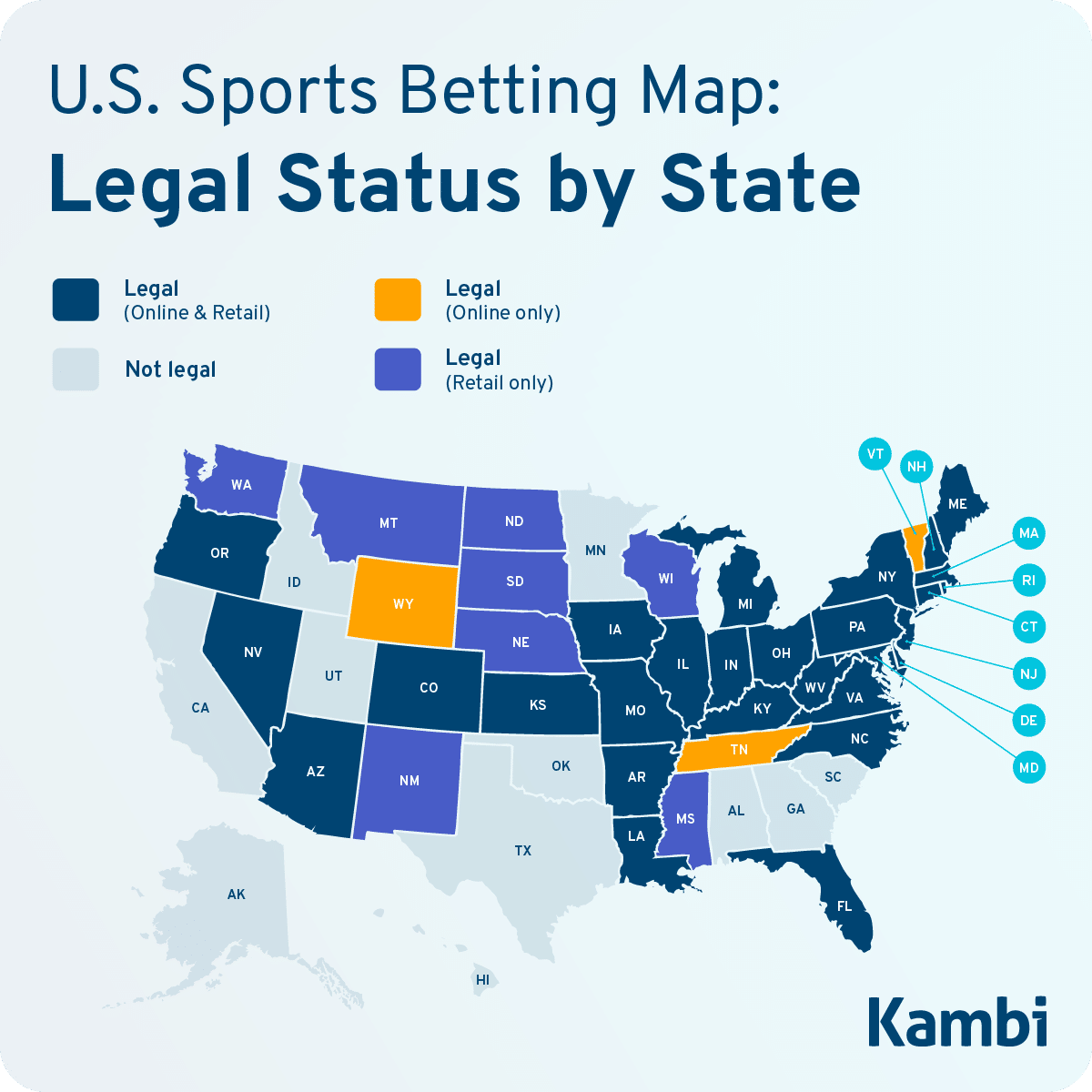
The largest cohort of states offer the most comprehensive access to sports betting, with both online/mobile platforms and physical retail sportsbooks operating legally. This multi-channel approach drives the highest volumes of wagering activity and provides operators with the broadest set of commercial opportunities.
The following states currently permit both online and retail sports betting:
*= indicates states that Kambi is operational in
| State | Key notes |
| *Arizona | Online and retail sports betting became legal in April 2021 following the signing of HB2772. Gaming in Arizona is governed by the Arizona Tribal-State Gaming Compacts between the state and its 22 federally recognised tribes. |
| Arkansas | Sports betting has been legal in the state since 2018. In 2022, Arkansas also approved online sports betting. |
| *Colorado | Robust regulatory framework with a wide range of licensed online and retail operators |
| Connecticut | Both retail sportsbooks and online sports betting are fully operational. Connecticut’s two gaming tribes, Mohegan and Mashantucket Pequot, and the Connecticut Lottery are authorised to offer sports betting. |
| *Delaware | A historic early adopter as one of the first states to offer sports betting following the PASPA repeal, with both retail and online capabilities now active. The Delaware Lottery is tasked with regulation and oversight of the industry through a monopoly with Kambi partner, Rush Street Interactive. |
| *Florida | Hard Rock Bet holds exclusive authorisation for online sports betting. Other operators are limited to pari-mutuel horse racing and daily fantasy sports. |
| *Illinois | Online and retail sportsbooks available. Bets on in-state college games and collegiate athletes are prohibited |
| *Indiana | Has embraced legal sports betting since 2019, with a well-established ecosystem of retail and mobile wagering options |
| *Iowa | Each licensed casino may operate a retail sportsbook plus up to two individual online betting platforms |
| *Kansas | Launched in September 2022 with licensed online sportsbooks alongside retail casino offerings |
| *Kentucky | Both online and retail sports betting are active throughout the Commonwealth |
| *Louisiana | Legal and live, with active sportsbooks operating across the state |
| *Maine | State law permits both online and retail sports betting |
| *Maryland | Online/mobile and in-person retail sportsbooks are both active |
| *Massachusetts | Online sports betting and retail sportsbooks are fully operational |
| *Michigan | Bettors can wager online within state borders or visit retail sportsbooks at most Michigan casinos |
| Missouri | Following voter approval of Amendment 2 in November 2024, online and retail sportsbooks launched in late 2025 — one of the more recent additions to this multi-channel category |
| Nevada | The original legal sports betting market in the US, Nevada has offered legal wagering for decades and pioneered the industry long before the PASPA repeal |
| New Hampshire | Legal since 2019, with both online and retail sports betting available |
| *New Jersey | One of the most mature and competitive US markets. Bets on in-state colleges are prohibited |
| *New York | Legal online wagering available from anywhere in the state, alongside in-person retail sportsbooks at New York casinos |
| North Carolina | Online sports betting available statewide, complemented by retail sportsbook locations |
| *Ohio | Several online sportsbook apps and physical betting locations launched in January 2023, with the market growing steadily since |
| Oregon | Sports betting launched in August 2019, with online wagering available and retail options at tribal casino sportsbooks |
| *Pennsylvania | One of the most established US sports betting markets, with online and retail options both available |
| Rhode Island | Legal and active online and in-person sports betting available statewide |
| *Virginia | Online sports betting is legal, with numerous licensed operators serving customers across the Commonwealth |
| *West Virginia | Bettors can wager online through licensed apps or visit retail sportsbooks at casinos and racetracks |
Several notable moments stand out within this group. Delaware holds a historically significant position as one of the earliest states to embrace legal sports betting in any form, having operated limited parlay wagering even under PASPA. After the 2018 ruling, it moved quickly to launch a fuller sports betting product. New Jersey played a decisive role in the legal landscape itself, as it was New Jersey’s challenge to PASPA that ultimately reached the Supreme Court and triggered the nationwide shift. Meanwhile, Missouri‘s late 2025 launch is a reminder that the US market continues to grow, albeit at a slower pace than after PASPA was initially repealed.
A smaller group of states has legalised in-person sports betting but has not yet extended authorisation to statewide online or mobile wagering. For operators, this represents a more limited commercial opportunity in most cases, but also an indication of potential future market development should regulations evolve.
The following states currently permit retail sports betting only:
| State | Key notes |
| *Mississippi | Online betting is technically permitted, but only while physically located on casino property. No statewide mobile sportsbook apps are available. |
| Montana | Legalised in 2019 via state lottery kiosks at licensed venues. Mobile wagering is permitted only while inside those establishments; statewide online betting remains prohibited. |
| *Nebraska | Nebraska sports betting has been legal since 2021. Online sports betting is prohibited. |
| New Mexico | Tribal casino locations across the state offer retail sports betting. No statewide online sportsbooks are active, and no formal legislative framework currently exists to authorise them. |
| *North Dakota | Tribal-only betting, permitted on reservation lands under laws that came into effect in December 2021. Does not extend to a broader commercial or online market. |
| South Dakota | Legal sportsbooks operate at several locations and at tribal casinos offering on-site wagering |
| *Washington | All wagers must occur on tribal lands with tribal casinos currently offering in-person sports betting. |
| *Wisconsin | Tribes negotiate individually with the state to amend gaming compacts to include sports betting, creating a tribe-by-tribe landscape. Online betting must also take place on reservation land or associated tribal properties. |
The most notable nuance within this group is New Mexico, which presents one of the more unusual legal situations in the country. Sports betting has never been formally legislated by the state legislature; instead, tribal casinos have operated sportsbooks under the authority of their existing gaming compacts, which permit “all forms of gaming.” This legal grey area has allowed retail betting to exist without a formal statute, but it also means there is no regulatory pathway for online sports betting in the foreseeable future.
A small but interesting subset of the US market has legalised online sports betting without permitting physical retail sportsbooks. This is an unusual configuration but reflects the legislative choices made in these states at the time of legalisation.
The following states currently permit online sports betting only:
| State | Key notes |
| *Tennessee | Sports betting is legal and live exclusively online, with no retail sportsbook locations authorised in the state |
| Vermont | Sports betting is available exclusively via online and mobile platforms |
| Wyoming | Legalised online sports betting without a retail component |
For operators, pure online markets can be operationally streamlined compared to managing both retail and mobile channels simultaneously, but the absence of physical touchpoints can limit brand visibility and customer acquisition. Tennessee, as the largest state by population in this group, represents the most commercially significant online-only market in the country. Its model is characterised by a mandatory hold requirement for operators, rather than a traditional tax on revenue, which distinguishes it from the norm and creates specific considerations for sportsbook operators building products for this market.
Despite significant growth across the country, sports betting remains entirely prohibited in a number of states. For operators, understanding these markets and tracking their legislative trajectories is an important part of long-term US strategy.
The following states currently have no legal sports betting:
| State | Key notes |
| Alabama | Despite multiple legalisation efforts in recent years, no legislation has passed. |
| Alaska | Sports betting is not legal and change is not expected in the near term. |
| California | The most populous U.S. state, yet ballot measures to legalise sports betting failed in 2022. Remains one of the most significant untapped markets in the country. |
| Georgia | Multiple bills failed during the 2024 legislative session; the issue will need to be revisited in a future session. |
| Hawaii | One of only two states with absolutely no legal gambling of any kind. Sports betting remains firmly off the table. |
| Idaho | Not legal, with no apparent plans to change that position in the near term. |
| Minnesota | Not yet legal, though daily fantasy sports and horse racing betting are permitted. |
| Oklahoma | Legalisation has been attempted multiple times in recent years without success. |
| South Carolina | Multiple legislative attempts have been unsuccessful to date. |
| Texas | The second-most populous U.S. state, making it one of the largest untapped sports betting markets in the country. Faces significant political barriers to legalisation. |
| Utah | One of only two states with a complete prohibition on all gambling, including sports betting. Change is highly unlikely in the foreseeable future. |
Two states in this group deserve particular attention from an industry perspective. California and Texas are the two most populous states in the country and would, if legalised, transform the scale of the US sports betting market once legalised. California’s failed 2022 ballot measures involved significant investment from both tribal gaming interests and commercial operators and demonstrated just how complex and expensive the path to legalisation can be in that state. Legislative attempts continue, but timelines remain uncertain. Texas faces its own political barriers, with sports betting facing opposition in the state legislature despite growing public support.
At the other end of the spectrum, Utah and Hawaii are unlikely to change their positions in any meaningful timeframe, given that their prohibitions are embedded in broader cultural and constitutional contexts around gambling.
Understanding which states permit sports betting is only the beginning. For operators actually entering and competing in these markets, the real challenge lies in adapting your sportsbook to meet state-specific regulations in the US, a process that requires both strategic planning and the right technology infrastructure.
There are a number of core areas that determine how effectively an operator can execute across multiple states.
Knowing the regulatory requirements in each state is foundational. Tax obligations, licensing conditions, responsible gambling mandates, geolocation requirements, and restrictions on certain bet types (such as collegiate wagering in Illinois) vary from state to state and can change with relatively little notice. Operators need robust compliance processes and access to up-to-date regulatory intelligence.
Platform flexibility is critical for operators working across multiple jurisdictions. A sportsbook technology layer that can be configured to enforce state-specific rules such as different age verification workflows, bet type restrictions, or promotional limitations without requiring a full redevelopment for each new market is a significant operational advantage. This is particularly relevant for operators entering new markets where speed to launch can be a determining factor in long-term market share.
Automating compliance processes reduces both operational risk and overhead. Manual compliance tracking across a portfolio of active states is both expensive and error-prone; operators who invest in automated tools are better positioned to scale without proportionally scaling their compliance burden.
Using data effectively, both to inform product and pricing decisions, and to demonstrate regulatory compliance, is increasingly a differentiator. State regulators may require detailed reporting on handle, hold, and responsible gambling activity, and operators who can produce this efficiently are better partners for regulators.
Kambi’s technology solutions are purpose-built to support operators navigating exactly this kind of complexity. Kambi’s Turnkey sportsbook platform provides operators with a fully managed, flexible, and compliance-ready solution that can be deployed across multiple jurisdictions, while Odds Feed+ gives operators access to Kambi’s market-leading pricing and risk management capabilities as a standalone product, making it ideal for operators with proprietary sportsbook technology while accessing best-in-class odds. For those looking to launch a successful online sportsbook in the US, understanding the technology requirements from day one is essential.
The US sports betting market is vast, fast-moving and genuinely complex. With more than 40 states now permitting some form of legal wagering and a handful of major markets including California and Texas, still on the horizon, the opportunity for well-prepared operators remains significant. But success in this environment requires more than knowing which states are live. It demands a deep understanding of how each state’s rules work in practice, and the technology infrastructure to operate compliantly and competitively across all of them.
Navigating that complexity is far more manageable with the right partner. Explore Kambi’s product suite, designed to elevate sportsbooks in the US and beyond — and find out how Kambi can power your next market entry.